Reimagining Land Use Systems through the Consumer

In conversations around land use and land use change, when should we involve the consumer? Should we involve them, and if so how? What might we miss out on if we don’t?
Farmers often identify consumers as responsible for changes in demand which affect their livelihoods. However, these consumers – the shoppers – will themselves be directly influenced by market forces and food system actors other than farmers, e.g. manufacturers/processors, retailers. So what is the consumer’s role in land use, and how can consumers be leveraged to promote and support land use change for a beneficial future in the immediate and long-term?
At the LUNZ Hub annual consortium meeting (17 September, Llandudno, Wales), our breakout session “Reimagining land use systems through the consumer” was inspired by 3 main themes: enabling on-the-ground-transition, consumer behaviour and stakeholder engagement. Our goal was to reimagine the consumer by shifting from a food focus to a land use focus. We identified key land use consumer groups, putting them at the centre of the land use system, with the aim of moving away from an ‘end user’ perspective to one of ‘agent of change’.
We looked at consumers of land resources. We asked who competes for what, in terms of products and services from land resources. We asked how the consumer can enable change (levers of change) in a newly oriented system with the consumer at the centre (see Figure 1).
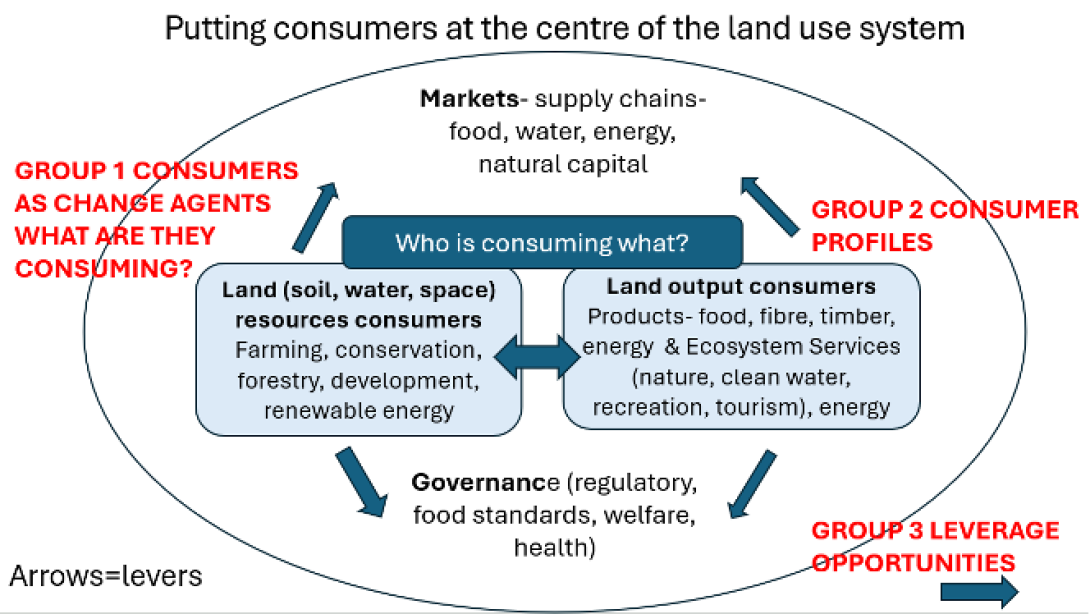
Figure 1 – Reimagining the land use system through the consumer (red text denotes the three break out groups)
Influential land use consumer groups
Influential consumers fell into three main groups:
- those who consume food
- those with individual or collective political interest and/or power (e.g. voters), and
- those with interests in preserving or experiencing nature (e.g. tourists, glampers, nature watchers) and its resources (e.g. investors in greener transport and sustainable alternatives).
Consumers were seen as having two main roles: passive consumption and active protection and conservation, with points of leverage identified through patterns of, and access to, food consumption, but also through citizens’ interests in land and energy, such as nature and resource protection, preservation and conservation.
Food consumers (the receivers or ‘end users’) were initially seen as the archetypal land use consumer. Interestingly, while this consumer type was seen to have varying degrees of agency over dietary choice and access to food, those without agency were also seen to have influence through advocacy and social movements to force necessary change.
The big challenge here, however, was to see consumers as land consumers, not just as food consumers. One useful point of differentiation focused on direct vs indirect consumption. Direct consumption focused on food purchased and consumed or otherwise disposed of in or outside the home. Indirect consumption was seen to encompass land use elements, such as energy-related products and services (e.g. electric/hydrogen vehicles, water transport, heat pumps, cookers and coolers), resources (e.g. water) and raw materials (e.g. timber and water), water being highlighted as a ‘big energy consumer’ in its own right. Beyond these tangible resources, cultural food narratives, focusing on the ‘cultural’ consumer, identified food as a strong part of the consumer’s culture, not simply energy or fuel. Cultural consumers are seen as especially influential at the local level, as valuers of local food, impacting on the success of local initiatives such as farmers markets and local authority decision-making. This may then have an indirect impact on land use decisions.
Collective consumer power through organized groups was seen as powerful and influential, including cooperatives, public procurement groups (schools, hospitals, prisons) and charities. For instance, the Wales Dairy Cooperative of Farmers, who share both risks and rewards while continuing to improve environmental performance and comply with pollution limits. Charities concerned with access to food and/or involved in food redistribution (e.g. food banks), who need to build networks and relationships with supermarkets and other suppliers, were also identified as potential levers of change. Other influential consumer communities included hospitality, the public health sector and the horticulture industry.
Limiting factors: Collective power over individual consumers emerged as a strong influence-limiting theme within the land use system. For instance, supermarkets wield power over the consumer and the rest of the supply chain, and their contracts with farmers are perceived as more influential than either regulation or subsidies and grants. However, the difficulty with engaging with supermarkets was highlighted, with private sector profit-driven goals also seen as a major limiting factor.
Consumer driven markets
Consumers are often seen as drivers of impact via market demand mechanisms, for instance through dietary shifts and other change drivers. It was noted, however, that the marketing narrative is not the same thing as marketing impact: people recognise the consumer as agent both for and against change, for instance resistance to adopt technological innovations in the beef and dairy sector (e.g. Bovaer).
From a system perspective, three key areas were highlighted: 1) Trade, where stronger consideration of imports and exports and their influence in the global food system and its ‘flow’ is needed. 2) Public procurement and spending, which is often viewed as a system mechanism for initiating or delivering change on farms through market development (e.g. horticulture, low-carbon food). However, understanding of its scale is key – public spending in Wales, for instance, arguably plays a smaller-than-expected role in the flow of food in the Welsh economy and in public spending: “Public procurement in Wales is equivalent to the food passing through the Culverhouse cross Tesco’s (Cardiff)”. And finally, 3) Supply chain diversification, e.g. the enablement and upward trend for direct sales.
Marketing mechanisms also came under scrutiny, as more money is perceived to be invested in advertising budgets than in positive behaviour change initiatives such as healthy eating campaigns, and the fact that the healthier option is often less affordable. A key distinction was made between growth and resilience, for example with the upward trend towards appetite suppressants such as Ozempic to deal with health issues such as obesity and non-communicable diseases (NCD) – highlighted as a wider potential change agent affecting food consumption markets and therefore land use change.
The Agency concept
The concept of agency focused on choice, poverty and power. From a marketing perspective, we saw the concept of choice as being influenced by consumers’ identity and value signalling, however it was acknowledged that agency is constrained by factors limiting choice, with cost, time and convenience identified as key pain points. Consumers are seen to experience lack of choice through constrained markets, finance, education and time. One reason for this may be that environmental benefits and policy are linked to social inequalities, with choice largely influenced by class, poverty and housing constraints (e.g. food deserts, local access to food), with the burden of resilience being carried by the poor. In terms of agency, consumers with low or no choice, through poverty or low income, were identified as wanting change: “(The) world is not working for me”. These consumers are seen as potentially strong agents for change through their ability to force change.
Leverage points
A number of levers and leverage points emerged. First, networks matter: an individual acting alone isn’t enough, however peer examples and learning are seen as key to support network development. Circles of influence are important to leverage through family, peers and social media, and consumers and disseminators of information. Second, it is important to consider scales of time (both short- and long-term), along with how scales of influence differ across different groups and in what ways. For instance, farmers’ scales of influence are centred mainly round contracts with buyers. They have less influence around subsidies and grants, and limited influence on legislation. For long-term levers, the critical role of schools and education was highlighted, such as using the education system to influence food norms, and develop the skills and knowledge of the whole family. Finally, we explored leverage in relation to the concept of ‘value’. One example from Welsh Government research suggests that focusing on key resources more generally may be effective – when individuals had been asked about what they valued about the uplands, for instance, the only thing they appeared to value were water supplies. The value of nature within and beyond the land may also be powerful levers, as illustrated by the public outcry around the felling of the Sycamore gap tree, and linkage to the arts.
Final Thoughts
Consumer power within land use and land use change frameworks is real, and is more powerful within local and regional communities formed of consumers. Consumers can be families, activists, adopters of good practice and rejecters of perceived bad practice, however they may be unequal in terms of the agency they have, and stakeholders may struggle to think beyond food, as the examples given above show. Consumers can successfully resist land use change – both good and bad – and are influential at all levels. Consumers can force change. The main emergent theme was that solutions should focus on land use community building, support of community initiatives, and strengthening of community relationships with policymakers. Scientifically accessible knowledge and understanding should be strengthened via mainstream education at all levels, increasing the connection with farmers and other land stakeholders, and with the land itself.
Reimagining land use systems through the consumer helps to identify interesting pathways. The individual consumer holds less power generally, however consumer groups have the potential for considerable influence. Value narratives are helpful in discussing the concept of choice and leverage points, however choice is subject to societal, economic and environmental constraints. Consumer driven markets may be powerful drivers of change and dietary shifts, which are highly relevant to discussions of land systems, land use and land use change. Consumer agency and indirect land consumption are therefore important elements to consider. Leverage points – both short-term and long-term – were identified to help develop agency to enable on-the-ground transition for net zero and stakeholder engagement within land systems more generally. Education systems, for instance, should be better leveraged to increase awareness and agency to support healthy and resilient land use. Ultimately, while the consumer appears to be situated at the end of supply chain, they have the agency to determine outcomes of change, whether or not they have the luxury of choice: poverty is a great hindrance, but offers the opportunity to force change.
Contributors: With thanks to our workshop contributors: Anna Macready, Julie Ingram, Martin Phillips, Evi Arachoviti, Lee Ann Sutherland, Prysor Williams, Rob Fraser, Erica Garrido Magaz, Anna Zalewska, Alan Radbourne, Ann Humble, Parag Acharya, Harriet Fraser, Daniel Struell, Emma Agnew, Mike Day, Jose Luis Fajanda Escoffie

Professor Anna Macready
Enabling on the Ground Transition

Professor Julie Ingram
Enabling on the Ground Transition
Subscribe to our Newsletter
A quarterly update of all LUNZ Hub activities, events and news stories.