
“I’ve seen his crops”: Making words work for good farmers
I’m sitting at a circular table in a ballroom in Glasgow, listening to a speaker sing the praises of a successful farmer. It’s the annual National Farmers Union of Scotland meeting, where the great and the good from the agricultural sector gather to hear about achievements and strategy for the future of farming.
This farmer, the speaker proclaims, has experimented with new agro-ecological techniques. Although this resulted in some yield losses at the start, the farmer is now achieving the same yields as his neighbours, with fewer inputs. A clear success story, told to encourage other farmers to adopt a similar approach.
But as the speaker continues on to describe another exemplar farmer, the farmer sitting beside me shakes his head, clearly unimpressed.
He leans over and whispers four fatal words:
“I’ve seen his crops.”
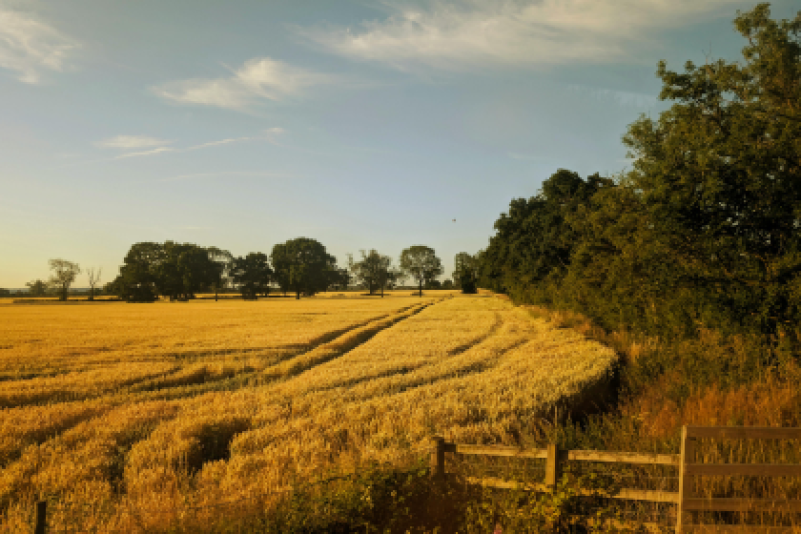
And there it was. Statements of apparent facts and figures have little purchase if the visual appraisal — the historic gold standard for measuring farmer achievement — does not match up.
I’ve written a lot about this phenomenon: the concept of the ‘good farmer’. It is based on interviews with hundreds of farmers over the past 20 years, across different sectors and systems. Farmers want to be seen, and recognised, as good at their jobs. They look over the fence to assess what their neighbours are doing, using this to appraise both the neighbour’s practices and their own.
Farmers put their best animals — and aim to plant their best crops — in their front fields. Those fields matter because they can be seen. They till them themselves, keeping children or less skilled labour for the back fields where mistakes are less visible. These social standards are reinforced constantly: through conversation, jokes down the pub, and apocryphal stories that last for years about a farmer who tried something new — and failed.
I grew up on a family farm, and these lessons were taught early. My parents would never have let us kids plough the front field. On drives into town, my father would routinely point out poor crops in neighbouring fields, using them as quiet warnings. Farming competence was learned visually, socially, and often without being explicitly stated.
A messy crop — or poor-quality livestock — costs a farmer more than profits. It costs reputation.
The farmer being promoted as an exemplar at the NFUS meeting will, no doubt, have lost what we academics would call ‘cultural capital’ when he first took on new approaches that jeopardised his yield. Gaining that capital back takes time. It requires a return to high yields, and some indication that the risk was worth it. Reduced input costs may satisfy that condition — but only if the crops look as good as they sound.
I’ve seen this dynamic over and over again. My early work on the ‘good farmer’ focused on organic farm conversion. Many dairy farmers were losing money due to low conventional milk prices and were looking to increase income by accessing organic premiums. But the cultural cost of accepting lower yields and weedy fields was too much for many, even for those who had already reduced their inputs to the point that they were “almost organic anyway”.
Some farmers did take the leap — and it was a leap. It meant learning to do things differently, networking with different farmers (some of them decidedly ‘strange’), and risking how they were seen by others. Some of those farmers converted back when conventional milk prices increased again. Others stayed, and over time developed a new understanding of what it meant to be a ‘good farmer’.
So what can we learn from the NFUS meeting? Is there a set of magic words that will convince farmers to try agro-ecological approaches?
There are a few things to consider.
Who is speaking.
In this case, it was a man working for an environmental organisation — always a source of suspicion — but one who had been raised on a farm. He stated that early in his talk. That matters. Shared background helps establish credibility, at least initially.
Who is being promoted.
A real farmer, making decisions in a commercial context, will always be more convincing than a research plot. But credibility is cumulative. It takes years to build and can be lost quickly. It may simply have been too early to promote this farmer as an exemplar. Perhaps his crops looked good this year, but not in previous ones. Or perhaps they only looked good on paper.
How it is being promoted.
There were no images or specific figures to support the claims. No way for farmers to apply their own gold-standard assessment. ‘Show, don’t tell’ — or better, ‘show, then tell’ — is far more effective.
What the net benefits are.
Yield losses were acknowledged, but the eventual yields were described as no better than neighbours’. There were no figures on the financial outcomes. Was there a meaningful net gain? And was it worth the effort and the reputational risk? Without that information, the story remains incomplete.
What cultural capital the farmer had to begin with.
Was this a farmer who was already central to his community and well respected? Or someone who had always been seen as a bit ‘odd’? Respected farmers will always carry more weight.
We know that a single talk at an event is unlikely to convince a farmer to change their practices. But it can put them off. While some farmers are more willing to take risks, for most it takes a steady accumulation of positive signals before they feel comfortable moving in a particular direction. That isn’t ‘resistance to change’ — it’s good judgement. Farming is a long-term business. It takes years to build up a herd or flock, and only months to tear one down.
So what are we to do?
We need to recognise that we won’t convince farmers without visible proof — and clear numbers. We need to recognise the cultural and financial costs of what we are asking of them. And we need to work with well-recognised ‘good farmers’, supporting them over time so that new practices can be seen — quite literally — to work.
There are no magic words. But there are credible messengers, visible evidence, and social signals that matter. If we take those seriously, environmental action in farming becomes much more likely to stick.

Professor Lee-Ann Sutherland
Principal Investigator
Subscribe to our Newsletter
A quarterly update of all LUNZ Hub activities, events and news stories.