Balancing Identity, Parenthood and Work: Insights from the Welcoming New Parents Workshop
What does it really mean to return to work as a new parent in land use, agrifood and research?
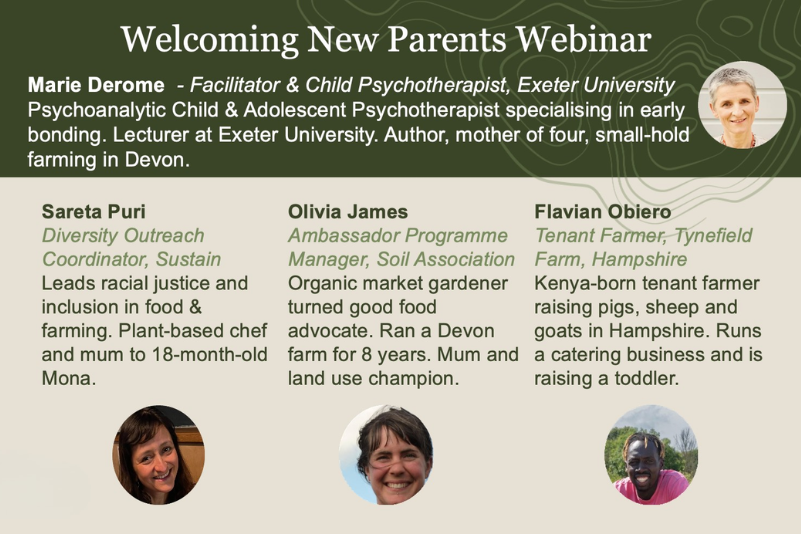
That was the question at the heart of a LUNZ Hub webinar on 9 March 2026. Social Justice and EDI are core tenets of the LUNZ Hub, and this event – part of the topic advisory group’s wider EDI webinar series – brought together three panellists (and parents!) for an honest, facilitated conversation: Sareta Puri (Diversity Outreach Coordinator, Sustain), Olivia James (former organic farmer, now at the Soil Association) and Flavian Obiero (tenant farmer, Hampshire), joined by facilitator and psychotherapist Marie Derome.
This webinar aimed to:
- provide a platform for meaningful discussion on welcoming new parents back to work
- facilitate empathetic dialogue supported by a psychotherapist
- engage with real-life stories from land use and agrifood settings.
- facilitate networking and knowledge exchange, and capture best practice
The webinar and our key takeaways can be viewed below. If after you’ve watched the session, you would like to give us feedback please complete the short form here.
The reality of new parenthood – and the guilt society adds to it
Marie Derome opened by naming a tension familiar to all the panellists: parenthood is idealised by society, yet workplaces, and other systemic support structures, are rarely built to accommodate it.
"When you give birth, you've got a baby - but you also enter the world of guilt. And I think the workplace kind of increases that guilt in a way that's really not helpful."Marie Derome, Facilitator
Flavian, who became a father the same year he started his farm tenancy and went self-employed, described the mental toll – but also the clarity it brought: “If it doesn’t work (for my child), I’m not doing it. I can’t get the time back.” Olivia, farming with no contingency plan when her first child arrived, reflected that the sector gave her no peer network to learn from.
"I definitely had lost a sense of self. I thought people didn't want me to come back - that they preferred my maternity cover."Sareta Puri, Sustain
Identity, confidence and returning to work
Sareta’s experience points to a gap many organisations miss: the difference between practical flexibility and genuine wellbeing support. Managers who actively check in – not just accommodate – make a real difference. Sareta was clear that for people who don’t naturally ask for help, passive offers aren’t enough: “I need someone to actually be outwardly supportive to me.”
Fathers, defaults and structural inequality
Flavian’s son spent three weeks in hospital when he was born but Flavian had to return to work after two weeks of paternity leave while his partner remained at the hospital. Sareta highlighted how default assumptions – GP registration, nursery contact lists, who adjusts their hours – systematically embed women as primary caregiver regardless of a couple’s intentions: “It just becomes expected.”
Key takeaways for the LUNZ community
Treat return-to-work as a season, not an event. Parental need doesn’t end at nine months — acknowledge the early years as an ongoing adjustment.
Build active, not passive, wellbeing support. Proactively check in with returning parents, especially those unlikely to ask for help.
Make events accessible. Creche provision at sector conferences is a diversity issue, not a nice-to-have.
Extend and normalise paternity leave. Two weeks is insufficient. Shared parental leave should be culturally normalised, not just available on paper.
Notice and name the defaults. Small administrative assumptions accumulate into structural inequality. Organisations can actively disrupt them.
This webinar was produced by Sophie Constant former project manager (EDI) with co-design with Marie Derome and Angelina Sanderson Bellamy TAG lead on Social Justice & Equality, Diversity and Inclusion, in collaboration with Miranda Addey our current project Manager (EDI). It was commissioned by Angelina. To contribute to future EDI sessions, contact Miranda Addey: [email protected].

Miranda Addey
Project Manager (Impact and EDI)

Angelina Sanderson Bellamy
EDI and Social Justice
Subscribe to our Newsletter
A quarterly update of all LUNZ Hub activities, events and news stories.