
Relationships, Curiosity and Confidence: Insights from the Inclusive Mentoring Webinar
What makes mentoring work, and who gets to benefit from it?
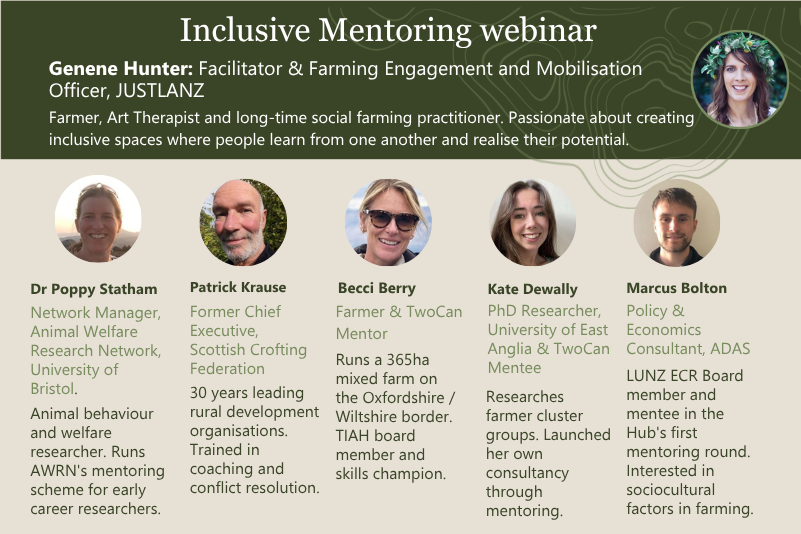
That was the question at the heart of a LUNZ Hub webinar on 22 September 2026. Social Justice and EDI are core tenets of the LUNZ Hub, and this event – a joint session with the LUNZ Hub’s Early Career Research board and part of the topic advisory group’s wider EDI webinar series – brought together five panellists, as mentors, mentees and scheme organisers, for an open, podcast-style conversation:
- Dr Poppy Statham (Animal Welfare Research Network, University of Bristol)
- Patrick Krause (former Chief Executive, Scottish Crofting Federation)
- Becci Berry (mixed farmer and TwoCan mentor)
- Kate Dewally (PhD researcher, University of East Anglia, and TwoCan mentee)
- Marcus Bolton (ADAS and LUNZ ECR Board)
- Joined by facilitator Genene Hunter, farmer, art therapist and Farming Engagement and Mobilisation Officer on the JUSTLANZ project.
About this event
This webinar aimed to:
- provide a platform for meaningful discussion on the value and practice of mentoring in land use, agrifood and academic contexts
- explore mentoring as a tool for equity, diversity and inclusion, particularly for people from underrepresented backgrounds or at early career stages
- share real-life experiences from the LUNZ ECR Board mentoring scheme, TwoCan Mentor and the Animal Welfare Research Network (AWRN)
- facilitate networking and knowledge exchange, and capture best practice
Full recording
See below for the full recording and key takeaways. If after you’ve watched the session, you would like to give us feedback on the session please complete the short form here.
It’s all about relationship
Patrick Krause set the tone early: whether it’s two people in a room, two people on a croft looking at animals, or a whole group learning together, mentoring always comes down to the relationship. Asked what makes a good mentor, the panel’s answers were refreshingly human. Patrick, pushed into senior management early in his career and feeling out of his depth, remembered the mentor who stood out because he could laugh at things – a quality he thinks is often overlooked when someone is terrified. Poppy pointed to a genuine interest in other people’s success, preparation before every meeting and, above all, the ability to listen.
“It’s not just about handing out advice, right? It’s about absorbing what the mentee needs and actively listening to what they want from the relationship.”Dr Poppy Statham, Animal Welfare Research Network
For Kate, who used leftover PhD training budget to join TwoCan and has since launched her own business, the most valuable thing was her mentor’s openness about the practicalities of self-employment – from finding an accountant to what insurance he paid for: “Stuff you can’t ask… in that context, it made perfect sense to have those conversations.”
A two-way, circular relationship
The panel was clear that good mentoring is not one wise person handing down knowledge. Patrick argued that mentors need humility, and mentees need curiosity and the confidence to push back.
“The mentee should be challenging the mentor as well, asking questions - yeah, but why? Why should it be like that? So it’s very much a circular relationship.”Patrick Krause, former Chief Executive, Scottish Crofting Federation
Becci and Marcus both stressed setting goals and managing expectations – while recognising these take time to emerge and can evolve alongside your mentor. Goals don’t have to be big: for Marcus, it was simply feeling confident enough to speak up in large meetings and overcoming the imposter syndrome he felt stepping from consultancy into a largely academic project.
Structure, safe spaces and organic connections
How do organisations balance structure with the value of informal, relationship-led mentoring? Each scheme represented has built in structure: TwoCan uses interviews and personality profiling to match pairs, and runs training days where you don’t know who in the room is a mentor or a mentee; AWRN has developed guides, quick-start notes and checklists for that crucial first meeting; and the LUNZ ECR scheme ran in six-month cycles with a matching survey. Marcus valued simply having a regular, protected slot to talk through new developments in his field with someone – space that is rare in a back-to-back online meeting culture.
Yet some of the best outcomes were unplanned. Patrick described trainees forming their own peer groups and mentoring relationships after training courses ended. Poppy shared that one of AWRN’s most successful pairings came about when no suitable senior academic was available, so two early career researchers were matched together – five years on, they are still collaborating and writing papers. As Genene reflected, what ties it together is creating a safe space where people can ask questions and challenge.
Mentoring across difference – and naming our biases
Patrick named gender inequality as the biggest problem he has seen in the land-based industries. Unconscious bias training with Changing the Chemistry, and work on the Women in Agriculture taskforce in Scotland, revealed how rife it was – and led to women-only training and group work that was very well received. He was candid that assuming “we are all equal” had been one of his own unconscious biases. Audience member Lucy Beattie, who took part in the same training, described it as life-changing: she now stops before anything she takes on to consider her own position of privilege.
Becci recalled lorry drivers arriving on farm and asking for “the farmer”, and admitted she was initially sceptical of women-only groups – until a younger woman told her she would never have known she could do it without seeing Becci in that role.
“Having that presence and that understanding of having people in those roles is so important… One thing mentoring does is it opens up some of those networks.”Becci Berry, Farmer and TwoCan Mentor
Kate reflected that, as a young woman mentored by an older man, she was comfortable because of her work in agriculture – but that differences like this can be a barrier for others, and are worth acknowledging openly at the start. Poppy noted that while most AWRN members are women, they are not progressing to senior positions at the same rate, and ethnic diversity remains low. AWRN has responded by adding EDI questions to its matching process so that mentees can be paired with someone who can support them in those areas.
Making mentoring accessible – and passing it on
Lisa Norton, who has worked with the Pasture Fed Livestock Association’s farmer-to-farmer mentoring programme, raised an important point: many farmers cannot afford to pay for mentoring. Becci and Kate both pointed to farmer cluster groups as a powerful, accessible route – facilitators and members often act as informal mentors, and some groups are beginning to formalise one-to-one pairings. Becci also highlighted knowledge exchange programmes such as those run by AHDB.
Mentoring also tends to renew itself. AWRN now includes a tick box on mentee applications for people who would also consider mentoring, and Marcus said his experience has made him keen to become a mentor. Becci became a mentor because her own mentoring had been so invaluable – and she still has mentors of her own, echoing Patrick’s point that mentors need mentors too. As Patrick put it, once you get involved, it’s almost addictive.
Key takeaways for the LUNZ community
Invest in the relationship. Good mentoring rests on trust, honesty, active listening and – not to be underestimated – a sense of humour.
Make it two-way. Encourage mentees to bring curiosity and to challenge, and mentors to bring humility and a willingness to rethink.
Use structure to create space, not rigidity. Matching, guides, goal setting and training help, but leave room for organic, peer and unexpected pairings.
Name difference and bias from the start. Build EDI into matching and first conversations, and consider dedicated spaces for underrepresented groups.
Widen access and keep the cycle going. Use free, local routes such as cluster groups, look beyond your own institution or sector, and invite mentees to become mentors.
To contribute to future EDI sessions, contact Miranda Addey: [email protected].

Miranda Addey
Project Manager (Impact and EDI)
Watch the webinar
Subscribe to our Newsletter
A quarterly update of all LUNZ Hub activities, events and news stories.