Nine Things We Learned About the Earth Rover Program with Simon Jeffery and George Monbiot
This conversation is the tenth instalment in a series of Talking Heads interviews with the LUNZ Soil Health and Carbon Dynamics TAG community. Throughout this series we will explore the key themes that the community will be working on throughout the LUNZ project lifecycle.
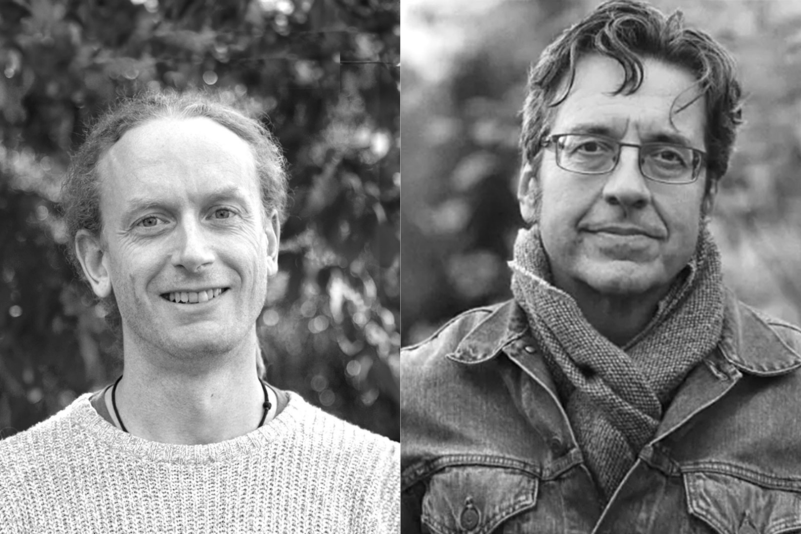
In this instalment, TAG leads Professor Pete Smith (University of Aberdeen) and Ellen Fay (Sustainable Soils Alliance) speak to Founder, Executive Director and Soil Science Lead, Professor Simon Jeffery, and Founder, Non-executive Director and Communications specialist George Monbiot at Earth Rover Program, a not-for-profit organisation developing new, low-cost technologies for “seeing” into the soil.
This article provides a summary of the key takeaways from the interview. The full interview can be viewed on the LUNZ YouTube channel.
The Earth Rover Program was developed to provide a means of observing soil depth and density without disturbance, something that to date has not been possible, with conventional methods such as digging pits or extracting cores damaging soil structure and providing information only at isolated points.
George Monbiot described how, working on his book Regenesis, he repeatedly encountered situations where a lack of soil insights restricted the ability to assess or improve farming practices, particularly in relation to soil structure and biological interactions.
The idea of applying seismology to soil emerged when George met Professor Tarje Nissen-Meyer, who was exploring environmental applications of seismology outside the oil and gas sector. Their conversations led them to identify soil as a suitable medium for seismic waves, which could be used to assess soil structure. Simon Jeffery, a soil scientist, subsequently recognised that this approach could address some long-standing gaps in soil monitoring.
This led to the development of what they refer to as “soilsmology”: the use of seismic signals to study soils. During this Talking Heads interview, we put some of the soil science and policy community’s questions to George and Simon about the system:
-
What is the Earth Rover Program?
The Earth Rover Program is a not-for-profit initiative developing a new way to measure and understand soils using seismology — the science of how vibrations travel through materials.
Instead of digging pits or taking soil cores, the Earth Rover Program sends seismic waves through the soil and analyses how they move. These waves respond to soil structure, horizons, bulk density, moisture, and compaction, making it possible to build up a picture of what is happening below the surface without disturbing the soil.
-
How does the Earth Rover Program compare to existing tools?
The Earth Rover Program fills a gap not currently addressed by existing soil monitoring tools and is designed to be used alongside existing methods for a fuller picture of soil health and the soil landscape.
- Soil pits and cores provide direct measurements but if not carefully done can interfere with soil structure.
- Remote sensing methods cover large areas but cannot see into the soil.
- Ground-penetrating radar works well for deeper layers but often struggles to identify or give an accurate picture of compaction and shallow topsoils.
The Earth Rover Program provides non-invasive, depth-explicit and spatially continuous information about soils. By measuring how seismic waves reflect, refract and change speed within the soil, it can map soil structure, layers and density across a field rather than at just a few points.
This makes the Earth Rover Program particularly useful for understanding compaction, soil horizons, and changes in physical condition that strongly affect crop performance, water movement, and water and carbon storage potential.
-
Who can use the Earth Rover Program?
The Earth Rover Program is designed for:
- Farmers and land managers
- Advisers and agronomists
- Soil scientists
- Regulators and environmental conservationists
- Citizen scientists
The Program’s long-term aim is to make gathering data simple and low-cost enough for everyday use. The tool is currently applied using specialist research equipment, but the team is investigating how to transition its use to small sensors similar to those used in mobile phones with the goal of enabling people to use their own phones and an app to collect information about soil depth, layers, and structure.
Citizen participation is essential to the Earth Rover Program’s model because the system depends on building a global database of soil signals from many different soil types, climates, and land uses which in turn will feed back into it to help build accuracy. As more people contribute, the database becomes more powerful and more useful for everyone.
-
What soil properties does the Earth Rover Program measure?
The Earth Rover Program focuses on physical soil properties, which underpin many other aspects of soil health.
Using different types of seismic waves, the Earth Rover Program can detect:
- Bulk density (how tightly soil particles are packed)
- Soil moisture (using waves that are highly sensitive to water)
- Soil layering and horizon depth (through wave reflections at boundaries)
- Compacted layers such as plough pans
- Variation across a field rather than relying on extrapolated data from a few samples
Because compaction shows up as a relative change in density, the Earth Rover Program can identify compacted layers even in naturally dense soils such as clays which if in good structure, should be more uniform in bulk density.
The system works at scales that are useful for land management, typically around the decimetre scale (10cm), with some results reaching about five centimetres.
Currently, the Earth Rover Program cannot identify stony soils. However, the scattering of seismic waves may allow the system to identify and eventually quantify stoniness, which is important for estimating soil volume.
-
What can the Earth Rover Program measure in relation to soil carbon?
The Earth Rover Program does not directly measure soil carbon concentration. However, it tackles some of the critical weaknesses in current soil carbon accounting.
Estimates of changes in soil carbon stocks depend on:
- Carbon concentration
- Soil depth
- Soil volume
- Bulk density
The physical properties (depth, volume, bulk density) are often poorly measured or simply assumed, leading to large errors or uncertainties in soil carbon stock estimates. The Earth Rover Program improves on current measurements collected for soil carbon baselining and measurement by:
- Identifying soil horizons and depth rather than relying on fixed assumptions (for example, topsoil depth is often assumed to be between 0-30 cm).
- Mapping bulk density across a field rather than relying on a few samples.
- Improving estimates of soil volume.
This additional information could greatly reduce uncertainty in soil carbon estimates.
There is also early research exploring whether soil organic carbon might be inferred indirectly, because it affects how soil particles are bonded and therefore how seismic waves behave, but this is still under investigation.
-
Does the Earth Rover Program measure soil biology and soil health?
The Earth Rover Program mainly measures soil physical structure, but that structure is closely linked to biological activity. Pores, aggregates, and connectivity are influenced by microbes and soil organisms.
In practice, the Earth Rover Program’s strength lies in providing a non-invasive soil structure and condition metric, similar in purpose to visual soil assessments but without digging.
-
How does the Earth Rover Program harness artificial intelligence and farmer knowledge?
The Earth Rover Program uses artificial intelligence to interpret seismic data in order to link this with large-scale soil databases. An AI system already connected to the LUCAS soil database allows users to query regional soil information.
In the future, the Earth Rover Program will compare seismic data with historical soil datasets so the system can infer what a soil type should look like in natural conditions and how it has changed over time.
Existing farmer knowledge is also important to the Earth Rover Program. Information on land use and management is collected during field work, and the Program plans for peer-to-peer knowledge sharing so users can exchange experiences linked to their soil data.
-
How user-ready is the Earth Rover Program?
The Earth Rover Program is currently in the research and development stage. Bulk density and soil volume mapping have been demonstrated; field-scale three-dimensional mapping is now being tested; and results are being validated through intensive physical sampling and laboratory analysis.
At present, scanning a field is not yet cost-effective for routine farm use. In the future, costs are expected to fall as sensors become cheaper, wireless, and more automated.
-
What does the future Earth Rover Program development and wider uses look like?
The Earth Rover Program aims to expand testing to more soil types and environments and develop a simple, non-invasive soil health metric. It is also looking to scale up wireless sensing and grow the global soil database through citizen participation.
Beyond agriculture, the Earth Rover Program could be used to support soil-focussed regulation and compliance checking, verification of soil protection and improvement schemes, and public understanding of soil as a living ecosystem.
The overall goal of the Earth Rover Program is to help move towards farming systems with higher yields and lower environmental impacts by giving people clearer information about what is happening beneath their feet.

Professor Pete Smith
Soil Health and Carbon Dynamics

Ellen Fay
Soil Health and Carbon Dynamics
Subscribe to our Newsletter
A quarterly update of all LUNZ Hub activities, events and news stories.